



How to Specify Hotel Wardrobes for Commercial Projects: Dimensions, Storage & Hardware
Learn how to design durable hotel wardrobes with practical storage, suitable door styles, and reliable hardware for long-term performance.

In this article
Consider a hypothetical 90-room business hotel where the wardrobes looked excellent in the sample room, with clean lines, mirrored doors and neatly arranged hanging rails. Six months after installation, the engineering team was addressing recurring hinge issues. During wedding season, families staying for three or four nights arrived with sarees, sherwanis and suitcases full of formal wear. The wardrobes lacked sufficient depth to accommodate full-length garments without them pressing against the doors, while heavy outfits caused two hanging rails to bow. The issue was not necessarily manufacturing quality, but a specification that had been designed around an assumed guest profile rather than the hotel's actual needs.
A guest-room wardrobe may look simple, but it experiences repeated daily use and can generate significant maintenance work across a property. When the same design is installed in every room, even a small specification error can become a recurring operational problem.
This guide explains how to specify hotel wardrobes for commercial projects, from planning storage and choosing door styles to selecting durable hardware and fixings. It focuses on hospitality guest rooms. For residential sizing, see our wardrobe size guide, or explore our hotel bulk furniture order guide for the end-to-end purchasing process.
The Direct Answer
To specify a hotel wardrobe, start by identifying the guests who will use it and how long they typically stay. Determine what needs to be stored, including the longest expected garments, folded clothes, luggage, an in-room safe and an iron. Next, choose a door style that suits the room layout and operational requirements, including noise and clearance. Finally, specify hardware and fixings designed for frequent use, such as concealed soft-close hinges with documented cycle-test ratings, full-extension drawer runners with verified load ratings, reinforced hanging rails and secure wall fixings. Verify these requirements in a mock-up room before production begins, as a specification error can be repeated across every room.
Why This Matters
It multiplies. A flaw in one wardrobe design can affect every room. A hinge that fails prematurely can lead to repeated maintenance calls.
It is used constantly. Guests open, close, lean on and sometimes slam wardrobe doors. Housekeeping and engineering teams use them regularly too.
It shapes the guest's first impression. A sagging door, squeaking runner or hanging rail that cannot support a coat can make the property appear poorly maintained.
It is expensive to retrofit. Changing hardware or interior layouts after hundreds of units are installed can take rooms out of service.
Step 1: Plan Storage Around the Guest
Not every hotel needs the same wardrobe. Before sketching the design, define the guest mix.
|
Guest / Stay Type |
Typical Storage Need |
Planning Implications |
|
Business, short stay |
A few hanging items, a small stack of folded clothes, a laptop bag and a safe |
Compact hanging space, a safe, an iron nearby and minimal folded storage |
|
Leisure, mid-length stay |
Hanging and folded clothes, swimwear and a few shoes |
A mix of hanging and shelf storage, a drawer and luggage space |
|
Wedding or family stays |
Long garments such as sarees, sherwanis and gowns, formal wear and multiple bags |
Adequate hanging height and depth, sufficient rail capacity, a luggage rack and floor space |
|
Extended stay / long-term |
A larger clothing collection, laundry, shoes and equipment |
Greater storage capacity, drawers, shelving and more robust rails |
|
Resort / beach |
Light clothing, swimwear and beach gear |
Ventilated, easy-to-clean interiors, hooks and space for damp items |
Identify the longest garments guests are likely to hang and measure the required clear hanging height and depth. In India, sarees, sherwanis, coats and gowns may require different hanging heights and depths depending on garment length, bulk and hanger type. Confirm the dimensions with the hotel operator and applicable brand standards rather than relying solely on a generic residential chart.
Residential wardrobe dimensions can provide an initial reference, but the required internal depth depends on the hangers, garments and storage system specified. Set the final dimensions according to the guest profile, brand standards and room layout.

Step 2: Choose a Door Style That Suits the Room
Door style affects noise, space, wear and the guest experience. There is no single right answer.
|
Door Style |
Strengths |
Watch For |
Best For |
|
Hinged doors |
Full access to the interior; familiar |
Swing clearance conflicts with the bed, luggage rack or other doors; hinge load |
Rooms with enough front clearance |
|
Sliding doors |
Need little front clearance |
Track debris, noise, off-track doors, access to only part of the interior at a time |
Compact rooms where swing space is tight |
|
Open wardrobe (no doors) |
No door hardware to fail; open, airy feel |
Clutter visible, dust, less privacy for belongings |
Boutique, design-led or resort rooms with tidy storage and curtain or screen options |
|
Alcove with curtain |
Low cost and low maintenance |
Can feel temporary; fabric needs cleaning |
Budget or short-stay properties |
|
Mirror-faced doors |
Adds a full-length mirror |
Heavier doors stress hinges; slamming risk |
Rooms without another full-length mirror |
When choosing, check the swing arcs against the bed, the luggage rack and the entry door in the actual room plan. Hinged doors require sufficient clearance to open fully, while sliding doors need less space in front of the wardrobe. Confirm the required clearance based on door dimensions, opening angles and the actual room layout.
Step 3: Specify Hardware for Repeated, Careless Use
Hardware is a common source of hotel wardrobe maintenance issues. Specify it deliberately, and ask for evidence rather than adjectives.
Hinges
-
Specify concealed, adjustable, soft-close hinges suited to the door weight, and ask the supplier for rated cycle-test information for the exact hinge model.
-
Heavier doors, such as mirrored or solid wood doors, may need more hinges or heavy-duty versions. Ask your manufacturer how hinge number and type were chosen for each door.
-
Confirm door opening angle, and check it on delivery. As the pre-dispatch checklist in our procurement guide suggests, test that hinges open to the required angle and that soft-close works.
Drawer Runners
-
Prefer full-extension runners with documented load ratings and cycle-test data.
-
Test drawers at full extension for smooth movement without binding, and confirm the stop mechanisms work.
-
Ask about runner mounting and fixing into the carcass, since weak fixings are a common failure point.
Hanging Rails
-
Specify rails sized and fixed for the load they will carry, including heavy coats and formal wear. Agree on a project-specific load requirement with the manufacturer and verify rail performance during pre-dispatch checks.
-
Consider rail fixings and end brackets that cannot be easily pulled loose.
-
Decide on hangers: fixed or anti-theft hangers, quantity per room and a hanger style that fits your garments.
Handles, Catches and Stops
-
Choose handles or finger pulls that do not snag clothing or luggage and can withstand repeated pulling.
-
Specify door stops or buffers to reduce slamming damage and noise.
-
Confirm catches or magnetic closers keep doors shut without being fiddly.
Locks and Safes
-
Decide whether wardrobes need locks, and whether an in-room safe sits in the wardrobe or elsewhere. Safes bring their own requirements for fixing, power and access height, so coordinate with the safe supplier and the interior design team.
Fixings and Stability
-
Confirm how the wardrobe is fixed to the wall or floor, particularly for tall units, to prevent tipping and rocking.
-
Specify adjustable feet or levellers so units sit properly on uneven floors.

Step 4: Specify the Carcass, Interior and Finish
-
Board and wood: Choose materials for humidity and use. Our furniture material guide and solid wood tabletop post explain how material and moisture behaviour affect performance, particularly in air-conditioned or humid settings.
-
Edge banding and exposed edges: Ask how edges are protected, since hotel doors take knocks and wipe-downs.
-
Interior surfaces: Interiors are touched by luggage and shoes. Specify interior finishes that are easy to clean and tolerate scuffs. See our finishes guide.
-
Ventilation: In humid or coastal locations, consider ventilation so garments and interiors do not turn musty.
-
Lighting: Interior lighting is useful, but it involves electrical coordination and safety review. Involve the electrical consultant and confirm what is permitted.
-
Housekeeping access: Consider a raised plinth or accessible base for cleaning, and shelf heights that housekeeping can reach comfortably.
Step 5: Verify With a Mock-Up Room
The most reliable way to catch wardrobe problems is to test one in a real room before the batch is made. Our post on mock-ups and sample approval explains why.
At mock-up, test:
-
Hang the longest garments you expect and check clearance.
-
Open and close each door repeatedly and check how it responds to normal and forceful closing.
-
Load rails and shelves to specification.
-
Pull drawers to full extension.
-
Check door swings against the bed, luggage rack and entry.
-
Check the safe height, power and access.
-
Have housekeeping and engineering use it and comment.
Expert Furniture Tips
-
Decide the hanger type and quantity at specification stage, since hanger choice affects rail design.
-
Keep hardware consistent across room types so spares and maintenance are simple.
-
Ask for spare hardware, such as hinges and runners, from the same batch.
-
Photograph the interior layout and hardware specification for each wardrobe type and keep it with the purchase order.
-
Consider tamper-resistant fixings for rails and shelves in high-theft environments.
-
Match wardrobe style to room character: open wardrobes can feel fresh in resort or boutique rooms, while closed wardrobes suit properties where privacy and tidiness matter more. For broader furniture planning, see our guide to choosing solid wood furniture for boutique hotels and resorts.
Common Mistakes Buyers Make
Mistake: Specifying from a residential wardrobe chart. Residential sizes assume one household's clothes and care. Solution: Set dimensions from your guest profile and brand standards.
Mistake: Ignoring long garments. Sarees, sherwanis and gowns may require different hanging heights and depths depending on garment length and bulk. Solution: Measure the longest garment you expect and design for it.
Mistake: Choosing hardware on price alone. Hinges and runners selected without considering durability and load requirements can lead to recurring maintenance issues. Solution: Ask for rated cycle data and test at mock-up.
Mistake: Choosing sliding doors without considering track maintenance. Tracks collect dust and can derail. Solution: Specify robust tracks and plan cleaning.
Mistake: Forgetting door swing against the bed or luggage rack. It leads to blocked doors and damaged edges. Solution: Overlay swing arcs on the room plan.
Mistake: Skipping the mock-up. Mistakes repeat in every room. Solution: Approve a full mock-up room before production.
Mistake: Not anchoring tall units. Rocking or tipping is a safety and noise problem. Solution: Specify appropriate anchoring and test stability.
Hotel Wardrobe Options Compared
|
Option |
Maintenance |
Guest Experience |
Cost Profile |
Best For |
|
Hinged closed wardrobe, soft-close |
Moderate |
Familiar, private |
Moderate |
Most business and leisure hotels |
|
Sliding door wardrobe |
Moderate to high (tracks) |
Space-saving |
Moderate |
Compact rooms |
|
Open wardrobe with shelf and rail |
Low (no doors) |
Airy, design-led |
Lower hardware cost |
Boutique and resort rooms |
|
Alcove with curtain |
Low |
Simple |
Low |
Budget or short-stay |
|
Premium built-in with interior lighting and safe |
Higher |
Premium |
Higher |
Upscale and extended-stay |
Note: This is general comparison guidance. Confirm specifics with your manufacturer and design team.
Designer Tip
Have the hotel operations team repeatedly test wardrobe doors, drawers and hanging rails during mock-up approval. Check for alignment issues, unusual noise, loose fittings or movement before signing off on production.
Professional Recommendation
Write a one-page wardrobe specification for each room type covering: storage requirements by guest profile, door style, hinge and runner type with required cycle ratings, rail load, handle and stop details, safe arrangement, fixing method, finish and mock-up tests. Attach it to the purchase order and use it as the pre-dispatch and delivery inspection checklist.
For specifications covering other hotel areas, see our guide to specifying hotel corridor furniture.
Planning Before You Specify
-
Define guest types and stay lengths.
-
List what each guest must store, including the longest garments.
-
Measure the room and overlay door swings.
-
Choose a door style per room type.
-
Specify hinges, runners, rails, handles, stops and fixings with evidence.
-
Specify carcass, interior finish and ventilation for the climate.
-
Coordinate safe, lighting and electrical requirements with consultants.
-
Approve a mock-up room and test with housekeeping and engineering.
-
Write the specification into the purchase order and inspection checklist.
Hotel Wardrobe Specification Checklist
-
Defined guest profile and typical stay length
-
Confirmed longest garment length and hanging space needed
-
Overlaid door swings against bed, luggage rack and entry
-
Chosen door style suited to the room
-
Specified concealed soft-close hinges with cycle-test evidence
-
Specified full-extension runners with load ratings
-
Confirmed rail load capacity and fixings
-
Chosen handles and stops that avoid snagging and slamming
-
Coordinated safe position, power and access height
-
Confirmed wall or floor fixing for stability
-
Specified interior finish and ventilation for the climate
-
Approved a mock-up room tested by operations
-
Requested spare hardware from the same batch
FAQs
What size should a hotel wardrobe be?
It depends on guest type and stay length. Plan from the longest garment you expect to hang, the amount of folded storage needed, and the room layout, and confirm with your brand standards instead of a residential chart.
Are sliding or hinged wardrobe doors better for hotels?
Hinged doors give full access but need swing space. Sliding doors save space but have tracks that need maintenance and give access to only part of the interior at a time. The right choice depends on the room.
What hardware should I specify for hotel wardrobes?
Concealed soft-close hinges, full-extension drawer runners, reinforced hanging rails, durable handles and door stops, plus secure fixings. Ask for rated cycle-test or load information for the specific products.
Should hotel rooms have open wardrobes?
Open wardrobes remove door hardware and feel airy, and can suit boutique or resort rooms. They show clutter and offer less privacy, so they suit properties with tidy storage and a design-led approach.
How do I test a hotel wardrobe before ordering the batch?
Approve a mock-up room, hang the longest garments, repeatedly open and close doors, load rails and shelves, pull drawers to full extension, check swing clearance and let housekeeping and engineering use it.
How should an in-room safe be coordinated with the wardrobe?
Decide early where the safe sits, its height, power and fixing, and coordinate with the safe supplier and the interior design and electrical teams so the wardrobe is built to suit.
Conclusion
A hotel wardrobe may seem like a simple piece of furniture to specify, which is exactly why important details can be overlooked. The properties that get it right plan storage around real guests, pick a door style that suits each room, specify hardware with evidence behind it, and test a full mock-up before production begins. The result is a wardrobe designed for long-term use with fewer maintenance issues. RadiantFurn's custom furniture and trade program works with hotel designers and procurement teams on solid wood pieces built to a brief, including interior layouts and finishes tailored to the property.

Written by the RadiantFurn team
We have manufactured solid wood furniture in Jodhpur since 2008 for homes, hotels, restaurants and offices. Our guides come from what we see on the workshop floor and on project sites.
Shop the look
Furniture from this guide
Read next
More guides from the Journal
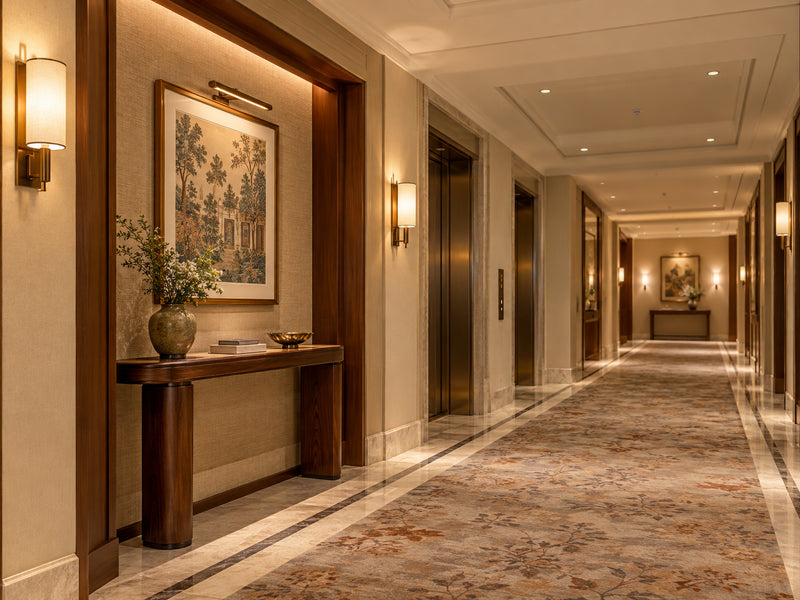
How to Specify Hotel Corridor Furniture: Console Tables, Seating & Clearances
A practical guide to specifying hotel corridor furniture, with a focus on clearances, safety, seating, consoles, housekeeping access and durability.
Read article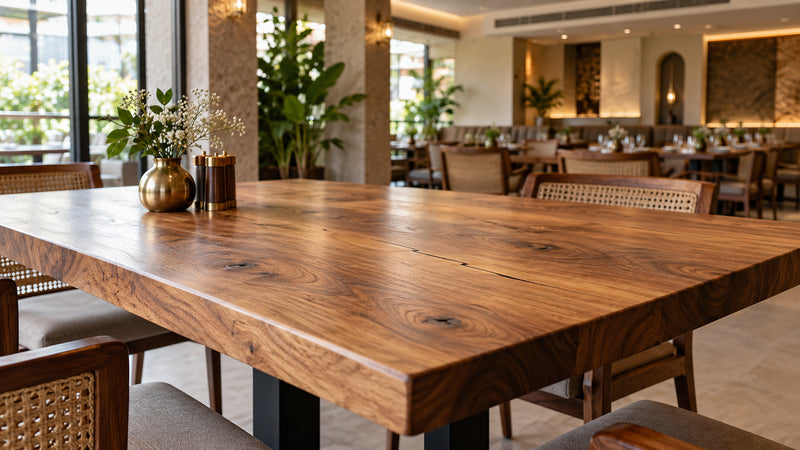
Why Solid Wood Tabletops Crack in Air-Conditioned Commercial Spaces - and How to Specify Against It
Solid wood tabletops can crack when moisture conditions change after installation. Learn how to specify moisture content, construction, fixings and finish for...
Read article
Furnishing a Heritage Hotel or Haveli Conversion in Rajasthan: Period Character Without Sacrificing Commercial Durability
A haveli conversion asks furniture to balance historic character with daily guest use. This guide covers how to choose period details and...
Read article